
Real-time reporting is defined as the continuous delivery of data insights at the moment events occur, giving business teams the information they need to act without waiting for scheduled batch runs or manual report cycles. Understanding why real-time reporting matters is not a theoretical exercise. Companies with strong real-time capabilities achieve over 50% higher revenue growth and net margins than peers who rely on delayed reporting cycles. That gap exists because speed of insight directly determines speed of action, and in competitive markets, delay has a measurable cost.
Why real-time reporting matters for decision-making
Real-time reporting cuts the time between an event and a business response from days to minutes. That compression changes how teams operate at every level of an organization.
When a customer service team can see a spike in complaint volume as it happens, they can reassign staff within the hour. When a supply chain manager watches inventory levels update live, they can trigger a reorder before a stockout occurs. These are not edge cases. Real-time analytics transforms slow feedback loops into timely interventions that reduce threats like fraud, supply chain disruptions, and customer churn before they escalate.
The benefits of real-time data extend beyond speed alone:
- Faster trend identification. Teams spot emerging patterns in hours, not at the end of a reporting week.
- Reduced decision latency. Operational choices that once waited for a Monday morning report now happen the same shift.
- Improved customer responsiveness. Live data on customer behavior lets service and sales teams personalize interactions in the moment.
- Decentralized decision-making. Front-line employees act on trusted data without escalating every question to management.
- Fewer compounding errors. Problems caught early stay small. Problems caught in a weekly report have already grown.
Real-time reporting capability is fundamental for modern market leaders who use it to empower employees and respond quickly to operational needs. United Airlines, Ikea, and Vanguard each built competitive advantages by giving employees access to live data at the point of decision.
When is real-time reporting actually necessary?

Not every business decision needs data from the last 30 seconds. Matching the reporting cycle to the decision window is the most practical framework for evaluating real-time reporting advantages.
| Decision type | Time window | Reporting cycle needed |
|---|---|---|
| Fraud detection | Seconds to minutes | Real-time streaming |
| Dynamic pricing | Minutes to hours | Near real-time |
| Operational staffing | Hours to one day | Intraday refresh |
| Tactical planning | Days to one week | Daily batch |
| Strategic forecasting | Weeks to months | Weekly or monthly |
The economic value of real-time reporting hinges on the cost of delay. If a decision can wait until tomorrow, daily or faster batch processing usually suffices. Fraud detection cannot wait. Dynamic pricing for an airline seat cannot wait. A quarterly budget review can.
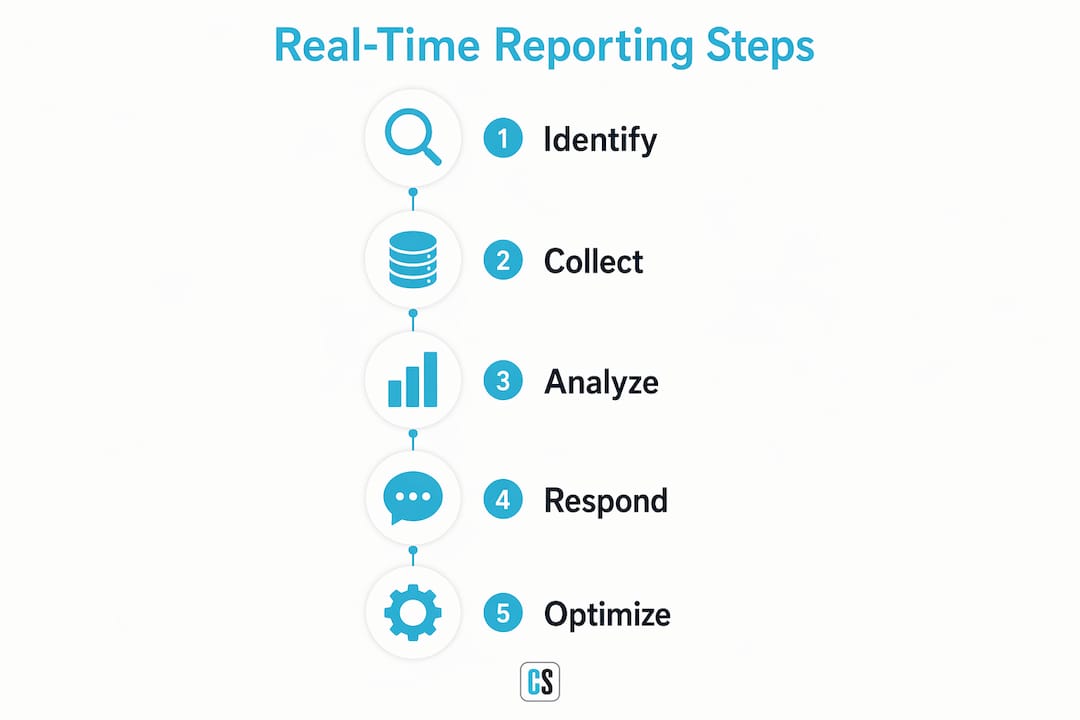
Most mid-market financial closes take 10–15 working days. Reducing that process latency to five days delivers more practical benefit than investing in streaming infrastructure for a decision that happens once a quarter. The real-time analytics significance is highest when the cost of a delayed response exceeds the cost of building and maintaining the live data pipeline.
Pro Tip: Before investing in streaming infrastructure, map your actual decision windows. If your most time-sensitive operational decisions happen daily, a well-designed intraday refresh often delivers the same business value at a fraction of the cost.
What are the biggest challenges in implementing real-time reporting?
The most common mistake organizations make is treating real-time reporting as a technology problem when it is often a process problem. Process latency is frequently the real bottleneck, not data infrastructure. Manual reconciliation, approval chains, and undocumented closing steps delay decisions far more than the speed of a data pipeline.
Key challenges to address before or during implementation:
- Data quality at speed. Unreliable real-time data adds risk despite fast availability. Validation rules must run at the same speed as data ingestion, or the reports become untrustworthy.
- Infrastructure cost versus business value. Streaming infrastructure costs significantly more than standardizing and documenting existing processes. Build the business case before the architecture.
- Integration with existing workflows. Real-time dashboards only help if the people who need them can access them within their normal work tools and routines.
- Avoiding unnecessary complexity. Adding live data feeds to decisions that are made weekly creates maintenance overhead without improving outcomes.
Real-time reporting enables automation that reduces human error and improves data accuracy across reporting cycles. Automation also removes the manual steps that introduce the most delay and inconsistency in traditional reporting workflows.
Pro Tip: Audit your current reporting process before selecting a real-time tool. Identify where data sits idle waiting for a human step. Eliminating those manual handoffs often cuts reporting lag by more than any technology upgrade.
Technology teams adopting AI-assisted workflows are finding that real-time data access directly improves the quality of automated responses and decisions. The pattern holds across industries: better data timing produces better outcomes.
What are the real-world benefits of real-time reporting?
The importance of real-time reporting becomes clearest when you look at specific industry applications where delayed data has a direct dollar cost.
- Fraud prevention. Financial institutions that detect anomalous transactions in real time stop fraud before it completes. Batch-processed fraud detection flags the same transaction 24 hours later, after the funds have moved.
- Supply chain agility. Retailers with live inventory visibility can reroute shipments, adjust reorder points, and prevent stockouts without waiting for an end-of-day report.
- Customer experience optimization. E-commerce platforms that track cart abandonment in real time can trigger a recovery offer within minutes, before the customer buys from a competitor.
- Dynamic pricing. Airlines, hotels, and ride-sharing platforms adjust prices continuously based on live demand signals. A pricing model running on yesterday's data leaves revenue on the table.
- Clinical and operational decisions in healthcare. Crystal Reports scheduling in healthcare environments delivers timely operational data that supports faster clinical and administrative decisions.
Accurate real-time reporting accelerates fraud detection, personalizes customer experiences, and helps organizations manage risk proactively rather than reactively. The shift from reactive to proactive is the core competitive advantage.
Self-service analytics tools play a growing role in making these benefits accessible. Dashboard reporting software gives business teams direct access to live data without requiring a data analyst to run every query. That access is what makes decentralized, fast decision-making possible at scale.
| Industry | Real-time use case | Business outcome |
|---|---|---|
| Financial services | Transaction fraud detection | Losses prevented before completion |
| Retail | Live inventory tracking | Stockouts reduced, margins protected |
| E-commerce | Cart abandonment monitoring | Revenue recovered within minutes |
| Healthcare | Operational scheduling data | Faster administrative decisions |
| Travel and hospitality | Dynamic pricing | Revenue per seat or room maximized |
Real-time analytics as an operational posture enables live intervention for high-value decisions. Delaying response until a weekly report produces economic value decay that compounds over time.
Key Takeaways
Real-time reporting delivers competitive advantage only when the reporting cycle matches the actual cost of delay for each decision type.
| Point | Details |
|---|---|
| Match cycle to decision window | Use real-time data for fraud, pricing, and staffing; use batch for strategic planning. |
| Fix process latency first | Manual steps delay decisions more than technology; audit workflows before buying infrastructure. |
| Validate data at speed | Fast but inaccurate data creates risk; build quality checks into the ingestion pipeline. |
| Empower front-line teams | Live dashboards let employees act without escalation, which speeds up operations measurably. |
| Measure the cost of delay | If a decision can wait a day, daily batch reporting often delivers equal value at lower cost. |
Real-time reporting requires more than fast data
The conversation around real-time reporting tends to focus on technology. Faster pipelines, streaming architectures, live dashboards. Those tools matter. But after working closely with organizations across industries, the pattern I keep seeing is that the companies getting the most value from real-time data are not the ones with the most sophisticated infrastructure. They are the ones who first asked a harder question: what decisions actually need to be faster?
Speed without purpose is expensive. I have watched organizations invest heavily in streaming data platforms only to discover that their analysts still export results to spreadsheets before making any decision. The bottleneck was never the data. It was the culture around how data gets used.
The organizations that win with real-time reporting treat it as an operational commitment, not a technology project. They identify the three or four decisions in their business where a one-hour delay has a measurable cost. They build live visibility into exactly those decisions. Then they stop. They do not try to make everything real-time, because not everything benefits from it.
Data literacy matters as much as data speed. A live dashboard that no one trusts or knows how to read is worse than a weekly report that everyone understands. The real-time analytics significance is realized only when the people closest to the decision have both the data and the confidence to act on it.
— Bobbieann Gordon
ChristianSteven Software automates real-time reporting delivery
ChristianSteven Software turns complex reporting workflows into reliable, automated processes that deliver the right data to the right person at the right time.
PBRS for Power BI report automation and ATRS for Tableau report scheduling handle report generation, formatting, and distribution without manual intervention. IntelliFront BI provides real-time KPI dashboards that give business teams live visibility into the metrics that drive their decisions. With SOC 2 Type II certification and more than two decades of BI automation experience, ChristianSteven Software gives enterprises the reliability they need to act on live data with confidence. Request a demo to see how automated reporting delivery fits your existing environment.
FAQ
What is real-time reporting in business?
Real-time reporting is the continuous delivery of data insights at the moment events occur, rather than on a scheduled batch cycle. It gives business teams current information to act on without waiting for end-of-day or weekly reports.
How does real-time reporting improve decision-making?
Real-time reporting reduces decision latency from days to minutes, allowing teams to respond to trends, risks, and opportunities as they develop. Companies with strong real-time capabilities achieve over 50% higher revenue growth and net margins than those relying on delayed reporting.
When is real-time reporting not necessary?
Real-time reporting is not necessary when the cost of a delayed decision is low. Strategic planning, quarterly budgeting, and weekly performance reviews do not require live data streams; daily or batch reporting cycles deliver equal value at lower infrastructure cost.
What is the biggest barrier to real-time reporting?
Process latency is the most common barrier, not technology. Manual reconciliation, approval steps, and undocumented workflows delay decisions more than data pipeline speed. Fixing those process gaps delivers faster results than upgrading infrastructure alone.
How do businesses start with real-time reporting?
Identify the two or three decisions in your organization where a one-hour delay has a direct cost, such as fraud detection or inventory management. Build live visibility into those specific decisions first, then expand based on measured business value.