
On-premises report automation gives BI and IT teams hands-free report generation, scheduled exports, and secure delivery that never leaves the local network. It keeps data residency intact, centralizes scheduling across BI platforms, and gives IT direct control over who gets what report, in what format, on what timeline. The sections below cover capabilities, security, deployment patterns, and a rollout checklist.
TL;DR:
- Keep identity checks, role based permissions, device checks, encrypted transport, and event logs in place; local hosting alone does not secure reports.
- Pilot 5 to 10 reports covering sensitive and routine workflows, measure delivery accuracy and time saved, and keep the manual process through one full cycle.
- Use a hybrid setup when external recipients or cloud triggers are needed, but source data must stay on local infrastructure.
- Test report bursting with a small recipient group before rollout; an error sent to 5 people is easier to contain than one sent to 500.
Table of Contents
- What On-Premises Report Automation Means and When to Choose It
- Core Capabilities to Expect From an On-Premises Automation Solution
- Applying Zero-Trust Principles to On-Premises Reporting
- Common Deployment Patterns and BI Platform Integration
- Implementation Checklist: Planning, Piloting, and Scaling
- Publisher Expertise and Proof Points
- Practical Perspective: Judging Whether On-Prem Is the Right Long-Term Fit
- How ChristianSteven Can Help: Product Fit and Next Steps
- FAQ
- Sources
What On-Premises Report Automation Means and When to Choose It
On-premises report automation runs on servers you control, generating, scheduling, exporting, distributing, and bursting reports without routing data through a third-party cloud. It handles the repetitive mechanics of BI reporting: pulling a report, rendering it in the right format, and sending it to the right person on a set cadence.
This approach fits a specific set of teams well:
- Compliance-driven organizations in finance, healthcare, or government that must keep sensitive data inside their own infrastructure
- Teams managing regulated data where cross-border transfer or third-party storage creates legal exposure
- Internal-only reporting operations where the audience, network, and data source all sit behind the same firewall
Cloud and hybrid alternatives offer easier setup and less infrastructure to maintain, but they trade away some control over where data physically sits. On-premises automation asks more of your IT team upfront in exchange for that control.
Core Capabilities to Expect From an On-Premises Automation Solution
A capable on-premises automation platform needs to handle four things well: when reports run, how they're rendered, where they go, and how they adapt to the recipient.
Scheduling should cover more than a daily timer:
- Time-based and calendar scheduling for routine reporting cycles
- Recurring schedules tied to business calendars like month-end or quarter-end close
- Data-driven and event-triggered schedules that fire when a database value changes or a file lands in a folder
Export and rendering needs to match how people actually consume reports:
- PDF and Excel for finance and executive audiences
- CSV for downstream data processing
- Paginated outputs for long operational reports
- Visual snapshots of dashboards for at-a-glance monitoring
Delivery has to reach people where they work: email inboxes, SFTP endpoints for partner exchanges, network shares for internal teams, direct database writes for downstream systems, and collaboration platforms where teams already track their work. Bursting, which splits one report into personalized versions per recipient or region, cuts manual segmentation work substantially, and a REST API lets your automation engine plug into broader orchestration tools instead of running in isolation.
Pro Tip: Test bursting logic on a small recipient list before rolling it out organization-wide. A formatting error that reaches 5 people is a fix; the same error reaching 500 is a mess.
Applying Zero-Trust Principles to On-Premises Reporting
Running reports on your own servers doesn't make them automatically secure. NIST and NCCoE guidance on Zero Trust Architecture treats every access request as untrusted by default, verifying identity, device posture, and resource sensitivity continuously rather than assuming anything inside the network perimeter is safe. That framing applies directly to a report automation engine sitting on your network.
Concrete controls worth building in:
- Authenticate and authorize every request against your IAM system, with role-based access control tied to each report's sensitivity
- Enforce device posture checks, network segmentation, and encrypted transport using VPN and TLS, with SFTP as the default channel for external delivery
- Log every generation and delivery event, with alerting on failures and a retained audit trail for compliance review
A single unverified access path into a reporting server undermines the rest of the controls around it: NIST's guidance recommends starting with an assessment of current resources, then iterating toward continuous monitoring rather than treating zero trust as a one-time setup. Data residency satisfies one compliance requirement, but auditors and regulators increasingly expect the IAM, logging, and device checks that sit around it.
Common Deployment Patterns and BI Platform Integration
Three deployment patterns cover most on-premises report automation setups, and the right one depends on how much outbound access your environment allows.
- Fully internal scheduler: The automation engine sits inside your network with direct access to report servers and internal delivery destinations like file shares and internal email. This pattern suits teams with no external recipients and the tightest security requirements.
- Isolated scheduler with secure tunnels: The engine stays on-premises but uses controlled outbound tunnels, such as SFTP or a locked-down VPN connection, to reach external partners or cloud storage without opening broad network access.
- Hybrid pattern: Cloud-based event triggers, such as a webhook or scheduled cloud job, kick off report generation, but the actual rendering and data access happen on-premises, keeping sensitive data off cloud infrastructure while gaining cloud-side orchestration flexibility.
Integration specifics vary by platform. Microsoft's Power BI communications overview positions Power BI Report Server as the on-premises option for organizations that need local report hosting, and connecting an automation engine to it typically requires a dedicated service account and connector configuration rather than a simple login. SSRS follows a similar service-account pattern, while Tableau and Crystal Reports each have their own authentication methods your automation layer needs to support natively.
For high availability, plan for a secondary scheduler instance and database failover before volume grows past what a single server handles comfortably.

Implementation Checklist: Planning, Piloting, and Scaling
Rolling out on-premises report automation goes smoother with a defined sequence rather than a single big-bang deployment; this step-by-step approach is well outlined in the Marketing Automation Checklist for SMBs.
- Inventory your reports. List every report, its owner, its data sensitivity, and who currently receives it.
- Define delivery SLAs. Set expected formats, delivery windows, and recipient lists for each report, then draft sample schedules against real business cycles.
- Run a pilot. Validate rendering accuracy, confirm delivery actually reaches test recipients, and deliberately trigger a failure to see how the system responds.
- Integrate security controls. Connect IAM and RBAC, turn on logging and monitoring, and write a runbook for common error scenarios before expanding further.
- Scale deliberately. Add bursting and event-triggered rules, schedule maintenance windows, and retire the manual processes the automation replaces only once the pilot has run cleanly for a full reporting cycle.
Pro Tip: Keep the manual process running in parallel for one full cycle after your pilot goes live. It gives you a fallback and a comparison point if the automated output looks off.
Publisher Expertise and Proof Points
We've spent more than two decades turning manual, error-prone reporting workflows into dependable automated processes across Power BI, SSRS, Tableau, and Crystal Reports environments. We maintain controls around data handling and system security.
For readers who want a concrete walkthrough, we document practical steps like configuring a single schedule for a Power BI on-premises report, covering schedule setup, rendering checks, and delivery verification. This article was written by Christian Ofori-Boateng.
Practical Perspective: Judging Whether On-Prem Is the Right Long-Term Fit
On-premises automation pays off when your team already has solid IAM, monitoring, and backup practices in place. If those are missing, building them alongside a new automation platform doubles the work and the risk.
Size a pilot around 5 to 10 representative reports spanning your most sensitive data and your most routine output. Measure success by delivery accuracy and time saved, not by how many features you turned on.
Hybrid setups make sense when some recipients sit outside your network but your source data can't leave it.
— Christian Ofori-Boateng
How ChristianSteven Can Help: Product Fit and Next Steps
Our product suite is designed to help with BI report scheduling, formatting, and delivery on-premises without hand-built scripts or constant manual intervention. Depending on your platform, that means:
- PBRS for Power BI and SSRS, handling scheduling, bursting, and secure delivery
- ATRS for Tableau Reports, with the same scheduling and export logic adapted to Tableau's connectors
- CRD for Crystal Reports, built for teams still running Crystal in production
- IntelliFront BI for centralized dashboards and KPIs alongside scheduled reporting
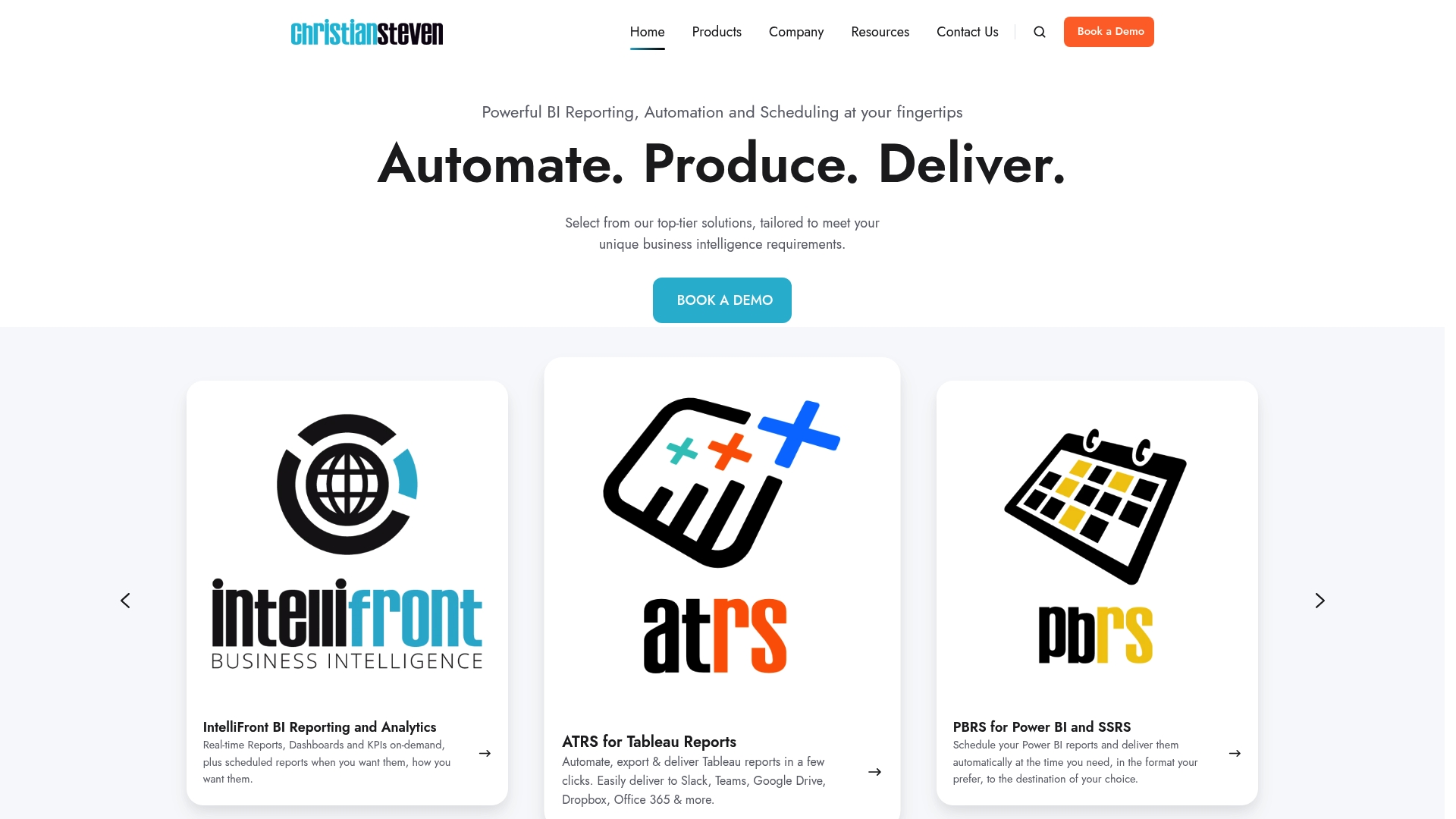
Each product supports flexible schedules, data-driven bursting, event triggers, and delivery to email, file shares, SFTP, and collaboration tools, replacing the manual handoffs and custom scripts most teams patch together over time. If your reporting stack spans Power BI, SSRS, Tableau, and Crystal Reports under one roof, a single scheduler across all four cuts down on maintaining separate automation logic for each.
The most practical next step is a demo or proof-of-concept run against a handful of your own reports, so you can see rendering accuracy and delivery timing before committing to a rollout.
FAQ
How does on-premises report automation integrate with existing BI platforms?
It typically connects through a service account and platform-specific connector, pulling report definitions and data directly from Power BI Report Server, SSRS, Tableau, or Crystal Reports without moving the underlying data off-site. Setup details vary by platform, with Power BI and SSRS generally following the same service-account pattern.
Is on-premises report automation more secure than cloud-based alternatives?
Neither option is automatically more secure. On-premises deployment keeps data physically local, which helps with residency requirements, but real security comes from applying zero-trust controls like IAM, device checks, and continuous logging regardless of where the system runs.
What is report bursting and when do I need it?
Bursting splits a single report into personalized versions for different recipients, such as regional sales managers each getting their own territory's data from one run. It's worth building once you're manually copying and filtering the same report for multiple audiences.
How big should a pilot deployment be before scaling?
A pilot covering a moderate number of representative reports, spanning your most sensitive and most routine use cases, gives enough signal on rendering accuracy and delivery reliability without the overhead of a full rollout. Run it through at least one complete reporting cycle before expanding.
Does licensing cover multiple BI platforms under one deployment?
Our product lines are organized by platform: PBRS for Power BI and SSRS, ATRS for Tableau Reports, and CRD for Crystal Reports, each available on a subscription or perpetual license. Pricing details are available on request through a demo.