
ChristianSteven Software's PBRS, ATRS, and CRD platform is the strongest on-prem report automation choice for enterprises running Power BI, Tableau, or Crystal Reports, because it combines self-hosted deployment, SOC 2 Type II certification, and data-driven scheduling that generic schedulers and cloud-only tools can't match. If your organization needs audit-ready, server-side control over reporting, start there. Everything below explains why, and what else to weigh.
TL;DR:
- ChristianSteven Software's platform offers cross-platform support, SOC 2 Type II certification, and data-driven scheduling that generic enterprise schedulers cannot match.
- Licensing costs depend on server or seat tiers, with no per-report metering, making it suitable for organizations needing audit-ready, scalable automation.
- The platform integrates Power BI, Tableau, Crystal Reports, and SSRS, supporting multiple formats and complex triggers, unlike platform-specific schedulers.
- Cost-effective for high-volume, regulated environments, but requires upfront investment and setup, especially if cross-platform delivery and compliance are priorities.
- Smaller teams with limited scope or control needs may prefer lightweight or custom scripts, but they lack built-in security and error management features.
Table of Contents
- Best On-Prem Report Automation Options and Who They Fit
- Comparing On-Prem Report Automation Tools Side by Side
- How Do You Evaluate an On-Prem Reporting Vendor?
- Which ChristianSteven Software Product Fits Your Stack?
- Getting Started With ChristianSteven Software
- Sources
- FAQ
Best On-Prem Report Automation Options and Who They Fit
Most IT teams evaluating on-premise reporting solutions land in one of three buckets: a dedicated enterprise on-prem product, a lightweight self-hosted utility, or a custom-built pipeline maintained in-house. Each has a real place, but they solve different problems at very different costs.
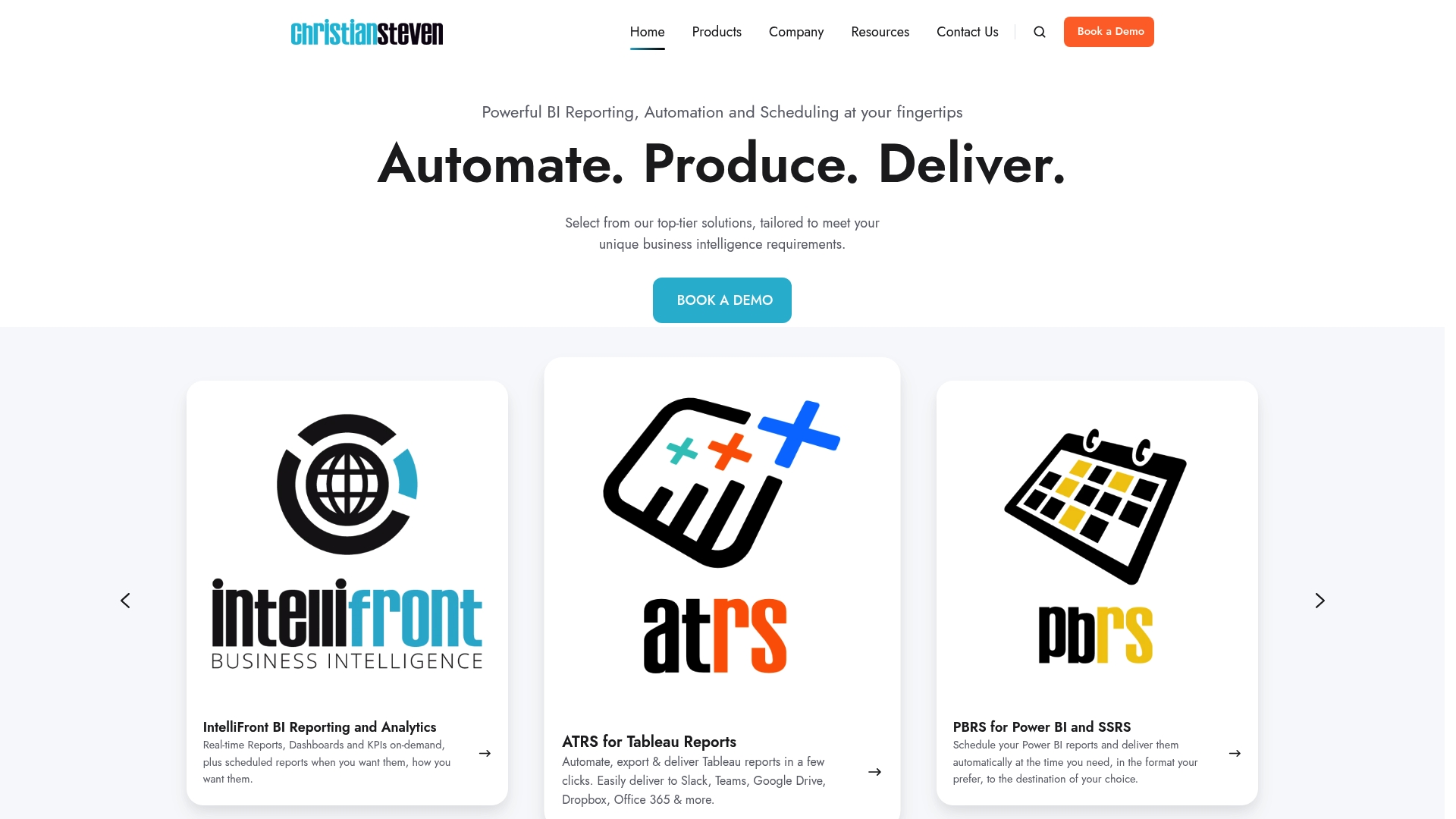
ChristianSteven Software (PBRS, ATRS, CRD, IntelliFront BI) is the dedicated enterprise route. PBRS handles Power BI report automation with data-driven subscriptions and scheduled exports. ATRS covers Tableau distribution with format fidelity built in. CRD automates legacy Crystal Reports workflows without forcing a rebuild. IntelliFront BI adds real-time dashboards and alerting on top. Together they cover the four BI platforms most enterprise reporting teams actually run, all deployed on your own infrastructure.
Enterprise platform-schedulers (the built-in scheduling features inside Power BI Report Server or Tableau Server itself) work fine for basic, single-platform needs but rarely handle cross-platform delivery, conditional triggers, or format control across PDF, Excel, and PPTX simultaneously.
Lightweight self-hosted automation tools can queue up simple export jobs but typically lack data-driven subscriptions, error-retry logic, or SOC 2-grade security controls, which becomes a problem the moment finance or compliance asks who has access to what.
Custom in-house scripts, often built around something like the seizue/auto-report-generator architecture, offer full control and can integrate OCR extraction or multi-provider fallback logic. They also mean your engineering team owns every bug, every upgrade, and every security patch indefinitely.
Here's how the pricing shape typically breaks down across the shortlist:
- ChristianSteven Software — perpetual license or subscription, priced by server/seat tier, no per-report metering.
- Enterprise platform-schedulers — usually bundled into your existing Power BI or Tableau licensing, but capability-limited.
- Lightweight self-hosted tools — low or no license cost, but higher hidden labor cost for configuration and maintenance.
- Custom scripts — no license fee, but ongoing engineering salary is the real price tag, plus the Adobe PDF Services API or similar third-party components if you need template-based document generation.
The decision usually comes down to how much internal engineering bandwidth you have versus how much control and audit trail your compliance team demands. Teams under real regulatory scrutiny tend to gravitate toward the dedicated product path fairly quickly.
Comparing On-Prem Report Automation Tools Side by Side
The table below lines up the dimensions that actually break deployments: where the software runs, what it talks to, how it schedules, and what security posture it carries.
| Dimension | ChristianSteven Software | Enterprise platform-scheduler | Lightweight self-hosted tool | Custom in-house build |
|---|---|---|---|---|
| On-prem support | Full self-hosted, native | Self-hosted (platform-bound) | Self-hosted, variable | Fully custom |
| BI platforms integrated | Power BI, Tableau, SSRS, Crystal Reports | Single platform only | Depends on connectors built | Whatever you code |
| Delivery formats | PDF, Excel, PPTX, HTML | Limited, platform-native | Often PDF only | Depends on libraries used |
| Scheduling & triggers | Cron, event-driven, data-driven | Cron-based mostly | Cron-based mostly | Whatever you build |
| Deployment footprint | Windows server, SQL/DB backend | Bundled with BI server | Varies, often minimal | Depends (commonly recommends PostgreSQL) |
| Security/compliance | SOC 2 Type II, encryption, SSO | Inherits host platform's security | Rarely certified | You own it entirely |
| Pricing/licensing | Perpetual or subscription, tiered | Bundled into BI license | Low cost, high labor cost | No license, high engineering cost |
A few things stand out once you lay it out this way. Cross-platform delivery is where the generic schedulers fall apart fastest. If your finance team pulls from Power BI and your ops team pulls from Tableau, a platform-bound scheduler forces you into two disconnected systems with no shared audit trail. ChristianSteven Software's approach, spanning all four platforms from one console, avoids that fragmentation entirely.
Security posture is the other clear differentiator. SOC 2 Type II certification means an independent auditor has verified controls over a sustained period, not just a point-in-time check. Custom builds inherit none of that automatically. You have to design encryption at rest, access logging, and disaster recovery yourself, and production-grade recommendations for custom report generators explicitly call out that development-tier database settings differ sharply from what production actually requires.

That said, a lightweight or custom approach isn't automatically wrong. A single-analyst team producing three internal PDF reports a week probably doesn't need enterprise licensing. The calculus changes once you're distributing to dozens of recipients, need role-based delivery, or answer to an auditor.
Enterprise product (ChristianSteven Software) pros: cross-platform coverage, SOC 2 certification, data-driven subscriptions, dedicated support SLAs. Enterprise product cons: licensing cost scales with server/seat count; requires initial setup investment.
Lightweight/custom approach pros: low upfront cost, full control over logic, good for narrow single-platform needs. Lightweight/custom approach cons: no built-in compliance certification, retry/error-handling logic must be built manually, maintenance burden falls entirely on your team.
How Do You Evaluate an On-Prem Reporting Vendor?
Before you book a demo, work through a technical checklist and an operational one. Vendors will happily talk features; make them answer the specifics that determine whether the tool survives contact with your actual environment.
Technical checklist:
- Does it support your full integration matrix (Power BI, Tableau, SSRS, Crystal Reports), or just one?
- Can it pull from your actual data sources, including on-prem SQL Server, Oracle, and cloud warehouses?
- Does it support SSO for authentication, or only local accounts?
- Is data encrypted both at rest and in transit by default?
- Does it produce audit logs for who ran, viewed, or received each report?
- What's the backup and disaster recovery story if the report server goes down?
Operational checklist:
- Can scheduling handle both fixed cadence and event-driven or data-driven triggers?
- How does it handle failed jobs: automatic retry, dead-letter logging, or silent failure?
- What delivery destinations are supported: email, shared drives, cloud storage, Slack or Teams?
- Does exported output preserve pagination and page breaks correctly in PDF, or does formatting break on complex reports?
- Does it support localization for multi-region report distribution?
When you get vendors on a call, ask them to run a sample report live using your own template, not a canned demo file. Ask about pilot scope limits, the rollback path if an upgrade breaks something, what the support SLA actually guarantees, and where the licensing line falls between a test environment and production.
Pro Tip: Scope your pilot to 30 days and three metrics: on-time delivery rate, hours of manual report-building eliminated, and error rate on exported files. If those three numbers don't move within the pilot window, the tool isn't the fit, regardless of how the demo looked.
Which ChristianSteven Software Product Fits Your Stack?
Each ChristianSteven Software product maps to a specific BI platform, so the right starting point depends on where your reporting workload actually lives.
- PBRS (Power BI) automates report scheduling, exports to PDF and Excel, and supports data-driven subscriptions so different recipients get personalized report slices automatically. It's built for teams running Power BI Report Server on-prem who need deterministic, auditable exports rather than manual downloads.
- ATRS (Tableau) schedules Tableau Server reports and distributes them to email, network folders, or cloud destinations while preserving formatting. Configuration typically centers on mapping Tableau views to delivery groups and setting refresh dependencies correctly.
- CRD (Crystal Reports) automates legacy Crystal Reports without requiring a migration, which matters for organizations that still depend on reports built years ago and can't justify a rebuild just to add scheduling.
- IntelliFront BI covers real-time dashboards and KPI alerting, useful when a team needs a live view rather than a static scheduled export.
Implementation timelines vary by scope, but enterprise onboarding typically follows a structured path: environment assessment, pilot configuration on a handful of reports, then phased rollout across departments. Support runs on documented SLAs, backed by the same SOC 2 Type II controls that cover the platform itself.
Why On-Prem Automation Beats DIY for Regulated Reporting
The honest case for a dedicated on-prem product over a homegrown script isn't feature count, it's accountability. ChristianSteven Software has operated in this space for more than two decades, which means the retry logic, format-fidelity edge cases, and SSO integrations have already been through years of enterprise contact that a new internal build hasn't. SOC 2 Type II certification and consistent customer satisfaction ratings aren't marketing decoration; they're the exact artifacts a security review will ask for. The ROI case is straightforward: fewer manual report-building hours, fewer formatting errors reaching stakeholders, and an audit trail that doesn't depend on someone remembering to check a log file. Budget real time for stakeholder alignment early. IT, compliance, and the report recipients themselves all need a seat in the pilot conversation before rollout, not after.
— Christian Ofori-Boateng
Getting Started With ChristianSteven Software
If your team is ready to move past manual exports, the fastest path is a direct trial against your own reports, not a generic demo. ChristianSteven Software offers dedicated product pages for Power BI report automation with PBRS and Tableau scheduling with ATRS, and for teams still running Crystal Reports, CRD keeps legacy formats intact while adding scheduling on top.
Bring three things to your first conversation: a sample report from your actual environment, a list of the data sources and delivery destinations you need covered, and the acceptance criteria that would make a pilot count as a success. That last piece matters more than people expect. A pilot without defined success criteria tends to drift. Security and procurement reviewers will also want to know upfront that ChristianSteven Software carries SOC 2 Type II certification and runs on documented enterprise support SLAs, which usually shortens that review cycle considerably.
| Scenario | Best-fit product |
|---|---|
| Power BI Report Server, need scheduled exports | PBRS |
| Tableau Server, need distribution and formatting control | ATRS |
| Legacy Crystal Reports still in production | CRD |
| Need live dashboards and KPI alerting | IntelliFront BI |
For more on why external schedulers often outperform native tools for SSRS environments specifically, see this breakdown on automating SSRS reports. Request a demo, bring your own report, and see how it handles your actual formatting before committing to anything.
Sources
For readers building or evaluating a custom pipeline, the Adobe PDF Services API documentation covers template-based document generation patterns, and the seizue/auto-report-generator project on GitHub shows a real open-source architecture with OCR and multi-provider fallback. For deeper product specifics, the Tableau report automation guide walks through ATRS configuration in more detail.
- seizue/auto-report-generator
FAQ
What Makes a Report Automation Tool "On-Prem"?
On-prem means the software, its database, and its scheduling engine run entirely on servers you control, rather than a vendor's cloud infrastructure, which keeps sensitive data inside your own network perimeter.
Is ChristianSteven Software Compatible With Power BI and Tableau?
Yes. PBRS handles Power BI report automation and ATRS handles Tableau, both deployed on-prem with data-driven scheduling and multi-format export support.
How Long Does an On-Prem Report Automation Rollout Take?
Timelines vary by scope, but a typical path runs from an environment assessment through a pilot on a handful of reports before a phased department-wide rollout.
Do On-Prem Reporting Tools Support SSO and Encryption?
Enterprise-grade on-prem tools like ChristianSteven Software support SSO authentication along with encryption at rest and in transit, both of which security reviewers typically require before approval.
Should I Build a Custom Report Automation Script Instead of Buying a Product?
A custom build makes sense for narrow, single-platform needs with available engineering time, but it puts the maintenance, security certification, and error-handling burden entirely on your team.