
The best approach to REST API reporting is an on-premises BI scheduler that triggers and delivers reports through REST endpoints rather than relying on native platform subscriptions or bespoke scripts. For Power BI, Tableau, SSRS, and Crystal Reports environments, Certain product families cover this job with SOC 2 Type II certification, data-driven bursting, and event-triggered delivery built in.
TL;DR:
- Rest API reporting automates report generation and delivery through REST endpoints, reducing manual exports and scripting dependence.
- On-premises solutions like ChristianSteven Software’s products support secure, scalable deployment with features such as data-driven bursting and event triggers.
- Key evaluation criteria include SOC 2 certification, multi-format output, scheduling depth, connectivity support, operational resilience, and licensing models.
- Proper network topology, authentication, scaling, and telemetry are critical for reliable and scalable deployment of on-prem REST reporting.
- Organizational ownership of credentials and templates is vital to prevent rollout failures, beyond mere technological considerations.
- ✓Automated report generation and delivery
- ✓Scheduled, formatted report distribution
- ✓Support for Power BI, Tableau, SSRS, and Crystal Reports
- ✓Event-triggered reporting workflows
Table of Contents
- What Enterprise REST API Reporting Actually Means
- How Do You Evaluate an On-Prem REST API Reporting Solution?
- Deployment and Integration: What Sysadmins Need to Plan For
- How Do You Know a Reporting Pipeline Is Actually Reliable?
- Mapping ChristianSteven Software to the Checklist
- What Actually Trips Up REST API Reporting Migrations
- How to Evaluate ChristianSteven Software for Your Reporting Pipeline
- Selected Sources and Documentation
- FAQ
What Enterprise REST API Reporting Actually Means
Enterprise REST API reporting is not about testing or monitoring APIs. It means automating BI report generation, formatting, and delivery, where REST endpoints handle the triggering and distribution instead of manual exports or fragile scripts. If you searched "best rest api reporting" expecting a rundown of API testing tools, that's a different discipline entirely. This article covers the automation layer that sits on top of Power BI, Tableau, SSRS, and Crystal Reports, not developer tooling for managing API traffic.
The shift matters because legacy rendering is expensive to maintain. Crystal Reports servers tied to a single Windows runtime, PowerShell scripts stitched together by whoever had time that quarter, and email rules nobody remembers configuring all create what practitioners call automation debt. Every fix requires someone who understands the original script, and that person eventually leaves.
Replacing that pattern with a REST-triggered pipeline decouples rendering from data access entirely. A JSON-to-PDF REST API pattern lets a stateless service generate a document on demand, cutting CPU load on your main servers and removing the need for a dedicated rendering machine running around the clock.
The practical benefits stack up fast:
- Rendering and data logic stay decoupled, so template changes don't require a data pipeline redeploy
- Infrastructure footprint shrinks since rendering can happen in short-lived processes instead of always-on servers
- Multi-format exports (PDF, Excel, CSV) come from one trigger instead of separate export jobs
- Multi-tenant safety improves because rendering avoids long-lived database connections during heavy runs
- Non-developers can adjust schedules and recipients without touching code
How Do You Evaluate an On-Prem REST API Reporting Solution?
Picking a platform, or deciding to build one internally, comes down to six criteria that matter more than any feature list a vendor hands you.
- Security and compliance. Look for on-premises deployment options, audit logging on every run, single sign-on support, and third-party attestations like SOC 2 Type II.
- Delivery destinations and formats. Confirm the platform pushes to REST webhooks, SFTP, SharePoint, and email, and exports in PDF, Excel, and CSV without a plugin workaround.
- Scheduling depth. Data-driven bursting (one report, many personalized copies) and event triggers (a file lands, an ETL job finishes, a database row updates) separate a real scheduler from a cron job with a nicer interface.
- Connector breadth. Native support for Power BI, Tableau, SSRS, and Crystal Reports matters more than exotic integrations you'll never use.
- Operational resilience. Retry logic, queuing, centralized logs, and a documented monitoring path are what keep 2 AM pages from happening.
- Deployment and licensing fit. Subscription versus perpetual licensing should match how your finance team actually budgets software, not how a vendor prefers to bill.
Pro Tip: Ask any vendor for a sample audit log and their documented retry policy before you sign anything. If they can't produce either in the first call, that tells you more than their feature deck ever will.
Event-triggered bursting tends to deliver the highest return of any single feature here, since it guarantees recipients get fresh data the moment it exists rather than on a fixed clock.
Deployment and Integration: What Sysadmins Need to Plan For
Rolling out REST-based reporting on-prem is mostly a networking and identity problem, not a reporting problem. Get those two pieces wrong and the rest of the project stalls regardless of how good the scheduling engine is.
Start with network topology. Decide early whether your reporting server accepts inbound webhook calls or only makes outbound requests, since that choice determines whether you need a reverse proxy, a DMZ segment, or specific NAT rules. Most enterprise IT teams prefer outbound-only patterns because they avoid opening inbound ports on internal servers.
Authentication needs the same scrutiny. Service accounts with scoped permissions, OAuth2 or JWT tokens with short expiry, and a documented secret rotation schedule beat static API keys that live in a config file for three years. TLS certificates need renewal automation too, an expired cert has taken down more scheduled report runs than any actual rendering bug.
Scaling considerations often get missed until the first big bursting run:
- Render worker pools should scale independently from the scheduler itself
- Database connection pooling prevents a 500-recipient burst from exhausting your DB connections
- Rate limiting protects downstream systems (email servers, SharePoint, webhook receivers) from a flood of simultaneous deliveries
- Containerized renderer components make deployments reproducible across dev, staging, and production
On-prem REST endpoints demand this level of planning precisely because there's no cloud provider absorbing the networking complexity for you.
How Do You Know a Reporting Pipeline Is Actually Reliable?
Reliability is provable, not assumed. You need telemetry on every single run: request and response payloads, render time, output file size, and final delivery status. Without that log trail, "the report didn't arrive" turns into a half-day investigation instead of a two-minute lookup.

A solid test approach runs staging jobs against synthetic data, fires test API calls that mimic production traffic, and deliberately triggers bursting scenarios with edge-case recipient lists (empty lists, duplicate emails, malformed addresses). Vendors and internal teams both skip this step under deadline pressure, and it's the step that catches the failure mode nobody anticipated.
Error handling separates production-grade systems from prototypes:
- Exponential backoff on failed delivery attempts instead of immediate, repeated hammering
- Dead-letter queues that capture permanently failed jobs for manual review instead of silently dropping them
- Idempotent retry calls so a retried job doesn't send the same report twice to the same recipient
A documented scheduling architecture with centralized logging and clear retry policies gives you the audit trail you'll need when someone asks why a compliance report was two hours late. Enterprise deployments should also come with defined SLA terms and a support escalation path, not a support email address that goes quiet after the sale closes.
Mapping ChristianSteven Software to the Checklist
ChristianSteven Software's four products line up against the evaluation criteria above without requiring a patchwork of separate tools for each BI platform.
- PBRS handles Power BI and SSRS, covering data-driven bursting, event triggers, and REST API delivery for Microsoft-centric BI stacks.
- ATRS automates Tableau report scheduling and distribution, useful for teams running Tableau alongside other platforms rather than replacing it.
- CRD modernizes Crystal Reports delivery, which matters if you're still running legacy Crystal Reports servers that need REST-based delivery without a full re-platform.
- IntelliFront BI centralizes dashboards, KPIs, and reports across the other three products into one access point.
| Checklist item | How the product family addresses it |
|---|---|
| On-prem deployment | All four products install and run on-premises |
| Security/compliance | SOC 2 Type II certification cited company-wide |
| Delivery destinations | Email, SFTP, SharePoint, and REST webhook support |
| Event triggers | Data-driven bursting and event-triggered runs across products |
| Platform coverage | Power BI, SSRS, Tableau, and Crystal Reports each covered |
A workable pilot follows a narrow scope: pick one to three reports, define the recipient list and output formats, test the REST trigger and confirm the audit log captures every step, then verify compliance sign-off before scaling further. A minimal proof-of-concept built around one parameterized report, one data-driven recipient list, two delivery destinations, and a few scripted failure scenarios is usually enough to validate the whole approach before committing budget to a wider rollout. Technical architecture detail lives in ChristianSteven Software's own scheduling architecture guide, written by Christian Ofori-Boateng.
What Actually Trips Up REST API Reporting Migrations
Most failed rollouts have nothing to do with the technology. They fail because nobody owns the credentials after the person who set them up moves teams, or because the "final" report template turns out to be one of six competing versions floating around finance.
Centralized scheduling fixes the technical debt problem: one dashboard replaces a dozen scripts nobody wants to touch. But the organizational work still has to happen first. Before you pilot anything, nail down who owns template changes, where service account credentials live, and who signs off on a new recipient being added to a distribution list. A five-minute governance conversation up front saves weeks of finger-pointing later.
— Christian Ofori-Boateng
How to Evaluate ChristianSteven Software for Your Reporting Pipeline
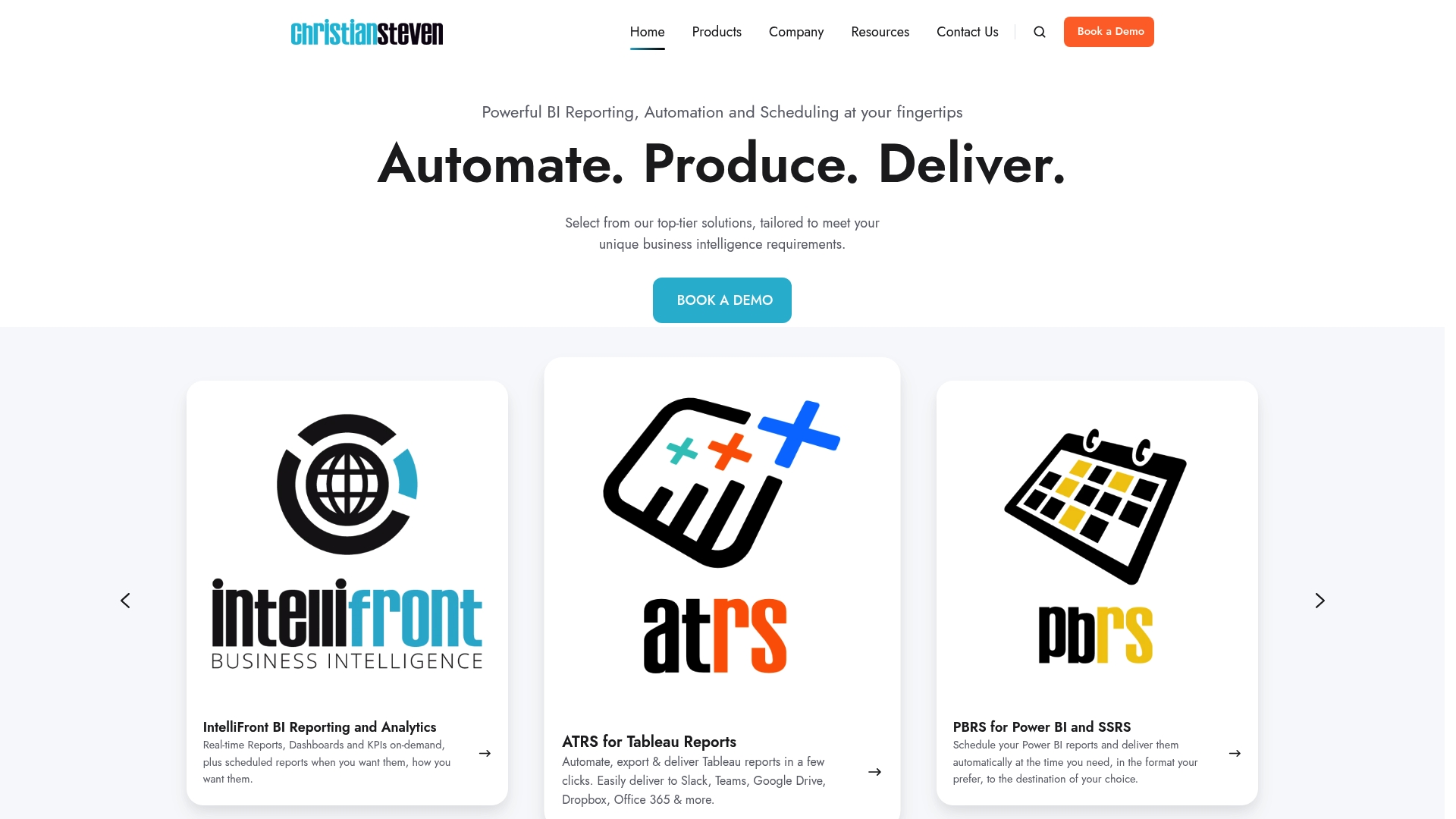
If you're comparing an on-prem REST reporting platform against the alternative of maintaining scripts and native subscriptions in-house, the calculation usually comes down to time. ChristianSteven Software's positioning is straightforward: PBRS, ATRS, CRD, and IntelliFront BI schedule, personalize, export, and securely deliver reports across your existing BI stack, replacing manual work and custom scripting with flexible, data-driven automation.
Before committing to a trial, request four things from any evaluation: proof of SOC 2 Type II attestation, an integration checklist covering your specific BI platforms, a sample REST trigger workflow you can test against your own data, and clearly stated SLA terms. If you run Power BI or SSRS, start with the PBRS product page for scheduling specifics. Tableau shops should check the ATRS automation page instead. For the full product family and to schedule a demo, visit the ChristianSteven Software trial page.
Selected Sources and Documentation
The legacy reporting to REST API guide covers the architecture pattern behind decoupled rendering. ChristianSteven Software's own report scheduling software overview and scheduling architecture explainer detail product coverage and operational practices referenced throughout this piece. Teams researching content and analytics strategy more broadly can also review this analytics for SaaS growth guide.
FAQ
What Is REST API Reporting in a BI Context?
It refers to automating report generation, formatting, and delivery for platforms like Power BI, Tableau, SSRS, and Crystal Reports, using REST endpoints to trigger runs and push output to destinations like email, SFTP, or webhooks. It is distinct from developer-focused API testing or API performance monitoring tools.
Which ChristianSteven Software Product Fits My BI Platform?
PBRS covers Power BI and SSRS, ATRS handles Tableau, and CRD manages Crystal Reports, while IntelliFront BI centralizes dashboards and KPIs across all three. Each product supports on-prem deployment with REST API delivery.
Does REST API Reporting Require Cloud Infrastructure?
No. The products discussed here run on-premises, which matters for organizations with data residency or compliance requirements that rule out cloud-only scheduling tools.
How Much Does ChristianSteven Software Cost?
Pricing for PBRS, ATRS, CRD, and IntelliFront BI is available directly through the ChristianSteven Software site, where both subscription and perpetual licensing options are listed.
What's the Fastest Way to Test Event-Triggered Bursting?
Build a minimal pilot with one parameterized report, one data-driven recipient list, two delivery destinations, and a handful of scripted failure scenarios to confirm retries and dead-letter handling work as expected.