
If you're managing report automation for Power BI, Tableau, SSRS, or Crystal Reports on your own infrastructure, the right move is a dedicated on-premises BI automation platform. There are product lines available that offer scheduling, formatting, and multi-channel delivery features worth putting on your shortlist. Such solutions handle granular scheduling, encrypted on-prem delivery, and pixel-perfect exports, features that teams running regulated or security-sensitive environments often require. This fits IT managers who can't push reporting infrastructure into the cloud.
TL;DR:
- Dedicated on-premises automation platforms support granular scheduling, encrypted delivery, and pixel-perfect exports suitable for regulated environments.
- Cloud-native reporting layers maintain consistency between dashboards and export reports but require a cloud data warehouse and lack advanced features.
- Native server features like Power BI Report Server or SSRS are cost-effective for small-scale needs but lack support for multiple engines and advanced delivery options.
- Lightweight scripting tools are quick for simple tasks but lack failover, error handling, and monitoring features necessary for larger workloads.
- Critical selection criteria include local deployment, precise scheduling triggers, comprehensive export formats, security compliance, and robust error monitoring.
Table of Contents
- What Are the Real Inforiver Alternatives for On-Premises Automation?
- How Do These Approaches Compare on the Dimensions That Matter?
- How Should IT Teams Choose an Inforiver Alternative?
- Planning a Migration Without Breaking Row-Level Security
- Where Each Alternative Category Actually Wins or Loses
- Does the Tool Fit Your Existing BI Stack Without a Rebuild?
- How Does Support Quality Compare Across These Options?
- What Does Total Cost of Ownership Actually Include?
- Can the Platform Handle Peak Reporting Loads?
- The Trade-Offs Nobody Puts in the Sales Deck
- Ready to Automate Your On-Premises BI Reporting?
- Sources
- FAQ
What Are the Real Inforiver Alternatives for On-Premises Automation?
Most searches for inforiver alternatives are really searches for one thing: a way to schedule, format, and deliver reports from on-prem BI engines without babysitting the process. Four practical categories cover almost every scenario an IT manager will face.
Dedicated on-premises automation platforms. These sit alongside your existing Power BI Report Server, Tableau Server, SSRS, or Crystal Reports environment and add scheduling, formatting, and multi-channel delivery on top. They fit organizations with strict data residency rules, air-gapped networks, or compliance mandates that forbid routing reports through third-party cloud services. Expect a Windows-based installer, local job scheduling down to the minute, and encrypted delivery to email, network shares, or internal portals.
Cloud or warehouse-native reporting layers. These platforms keep a single live metric definition that feeds both dashboards and exported reports, which avoids the mismatch you get when a PDF export shows different numbers than the live dashboard. They suit teams already committed to a cloud data warehouse who don't have on-prem constraints.
Native server features. Power BI Report Server, SSRS subscriptions, and Tableau's built-in scheduler can each handle basic recurring exports. Power BI Report Server is narrower than the full Power BI Service, closer in scope to SSRS, with different refresh and distribution trade-offs. It's a reasonable starting point for a small team with light delivery needs, but it lacks apps, easy external sharing, and advanced conditional logic.
Lightweight or self-hosted scripting tools. Custom scripts or open-source schedulers can automate simple exports for a single team. They work until someone needs run history, error alerts, or delivery to a dozen stakeholders across three formats. That's usually when teams migrate to a purpose-built platform.
A finance department needing monthly PDF packets sent to 40 external clients has different needs than a single analyst automating a weekly CSV pull. Match the category to the actual workload before you shop by feature list.
How Do These Approaches Compare on the Dimensions That Matter?
Here's how the four categories stack up across the criteria IT teams actually use to disqualify or shortlist a tool.
| Dimension | On-prem automation platform | Cloud/warehouse-native | Native server features | Lightweight/self-hosted |
|---|---|---|---|---|
| Deployment | Installed on-prem, full control | Cloud-hosted, no local install | On-prem, tied to existing server | On-prem, custom-built |
| Supported engines | Power BI, Tableau, SSRS, Crystal Reports | Usually one warehouse/BI stack | Single engine only | Whatever the script targets |
| Scheduling granularity | Minute-level, cron-style, event-triggered | Interval-based, sometimes capped | Fixed subscription intervals | As coded, no failover |
| Delivery channels/formats | Email, PDF, Excel, CSV, PowerPoint, SharePoint, Slack/Teams, S3 | Email, links, limited export formats | Email, file share, basic formats | Email or file drop only |
| Security/compliance | SOC 2, encrypted attachments, domain verification | Vendor-dependent cloud compliance | Inherits host server's security | None built in |
| Monitoring/run history | Detailed logs, error handling, retry logic | Platform dashboards, limited detail | Basic subscription logs | Manual, if any |
| Licensing model | Per-server or subscription, on-prem | Usage or seat-based subscription | Bundled with BI platform license | Free, but no support cost |
Three red flags disqualify an approach fast: no encrypted delivery option, no run history or failure alerting, and no support for the specific export format finance or compliance actually needs (usually pixel-perfect PDF or Excel).
Reading this table correctly means starting from your constraint, not your wish list. If data residency rules block cloud transit, the warehouse-native column is off the table regardless of its features. If you're running all four engines (Power BI, Tableau, SSRS, and Crystal Reports) in parallel, native server features stop scaling the moment you need cross-engine consistency. Enterprise BI platform choice depends heavily on whether the requirement is governed reporting, self-service exploration, or embedded analytics, and that distinction should drive your shortlist before pricing does.
How Should IT Teams Choose an Inforiver Alternative?
Rank requirements before you rank vendors. Here's the order that actually prevents a bad purchase:
- On-premises deployment support. If it can't install locally and encrypt delivery on your network, eliminate it immediately, no matter how good the UI looks.
- Scheduling granularity and triggers. Confirm it supports minute-level cron scheduling plus event or data-threshold triggers, not just daily/weekly intervals.
- Delivery channel coverage. Check for PDF, Excel, CSV, and PowerPoint export alongside email, Slack/Teams, and SharePoint or S3 delivery. Slack delivery has become a standard expectation for teams that live in chat tools.
- Security and compliance posture. SOC 2 Type II certification, encrypted attachments, and domain verification are baseline, not bonus features.
- Monitoring and error handling. Ask for a live demo of the run-history log and what happens when a report fails to generate or a mail server rejects delivery.
- API and integration depth. REST API access matters if you need to trigger reports from external systems or pull run status into your own monitoring stack.
When you get vendors on a call, ask directly: What's the support SLA? What does the upgrade path look like for major version changes? Is backup and restore built in, or manual? Does it integrate with Active Directory or LDAP for permissions? Row-level security and API access are core checklist items that separate enterprise-grade tools from lightweight ones.
Pro Tip: Run the proof of concept against your worst-case report, not your easiest one. Pick the file with the most conditional formatting, the largest recipient list, and the tightest delivery deadline. If it survives that, score the vendor high; if it breaks, you just saved yourself a bad contract.
Planning a Migration Without Breaking Row-Level Security
Migrating report automation off manual processes or a legacy scheduler takes more planning than flipping a switch. Start with an inventory: list every report, its source engine, current schedule, recipient list, and format. This step alone surfaces reports nobody remembers why they're still running.
Test export fidelity before cutover, not after. Pixel-perfect Excel and PDF output matters most for finance and compliance deliveries, and paginated report formatting can behave differently across platforms if you don't validate it against real production data.
Credentials need their own checklist item. Service accounts for Power BI, Tableau, SSRS, and Crystal Reports connections should use least-privilege access, and you should confirm the new platform supports credential rotation without breaking existing schedules.
Row-level security (RLS) deserves special attention. If your Power BI or Tableau reports rely on RLS to restrict what each recipient sees, verify the automation layer respects those rules at export time rather than generating a single unfiltered file. Test this with at least two different user roles before go-live, and document the expected output for each. A migration that silently breaks RLS is worse than the manual process it replaced.

Where Each Alternative Category Actually Wins or Loses
Dedicated on-prem platforms win on control and compliance but lose points on setup time. You'll spend more hours configuring the initial install and connecting each report engine than you would signing up for a cloud tool. That upfront cost buys you data residency guarantees and encrypted delivery you fully control.
Warehouse-native platforms win on consistency. Keeping dashboards and exports on one live metric definition eliminates the classic problem of a PDF showing last week's numbers while the dashboard shows today's. They lose on flexibility if your organization spans multiple BI engines instead of one warehouse.
Native server features win on cost. If you're already paying for Power BI Report Server or SSRS, the scheduler is free. They lose on ceiling. Power BI Report Server allows scheduling without cloud caps but skips dashboards, apps, and several integrations that growing teams eventually need.
Lightweight scripting wins on speed for a single, simple use case, and loses almost everything else: no monitoring, no failover, no audit trail. It's a starting point, not a destination, for any team managing more than a handful of recurring reports.
Does the Tool Fit Your Existing BI Stack Without a Rebuild?
The best on-prem automation tools connect to your existing Power BI, Tableau, SSRS, and Crystal Reports environments without forcing a rebuild of reports you already have working. That means checking whether the platform reads your existing report definitions directly or requires you to recreate them in a proprietary format. The latter is a hidden cost that shows up months into a rollout.
Integration friction usually shows up in three places: authentication (does it play nicely with your existing service accounts and Active Directory?), data source connections (does it require its own separate connection layer?), and output consistency (does the exported file match what a user sees inside the native BI tool?). A platform that answers yes to all three tends to onboard in days rather than weeks.
For IT managers running mixed environments (say, Power BI for finance and Tableau for operations), a single automation layer that speaks to multiple report engines cuts the operational overhead of maintaining separate scheduling tools for each platform. That consolidation is often the deciding factor over any single feature.
How Does Support Quality Compare Across These Options?
Support quality varies more than feature lists suggest. Dedicated on-prem vendors typically offer named support contacts, documented SLAs, and direct access to engineers who understand your specific BI engine's quirks. That matters when a scheduled delivery fails at 2 a.m. before a board meeting.
Cloud/warehouse-native platforms lean on ticket queues and community forums, which works fine for common issues but slows down when your problem is specific to an on-prem integration they don't fully support. Native server features (SSRS subscriptions, Power BI Report Server) get whatever support Microsoft bundles with the platform license, which is thorough for the platform itself but silent on third-party automation questions.
Self-hosted scripts have no vendor support at all. Whoever wrote the script is the support desk, and when that person leaves the company, so does the institutional knowledge. Community resources (forums, documentation, and user groups) tend to be strongest around the most widely deployed platforms, so check activity levels before assuming a smaller tool has an active community behind it.
What Does Total Cost of Ownership Actually Include?
License price is the visible cost. The hidden ones are what break budgets. Factor in implementation time (hours spent configuring connections, testing schedules, and training staff), ongoing maintenance (patching, upgrades, and credential rotation), and the cost of downtime when a scheduler fails silently for a week before anyone notices.
Per-server or per-seat licensing models shift cost differently as you scale. A per-server on-prem license can be predictable for a stable environment but expensive if you're constantly spinning up new report servers. Subscription models smooth out cash flow but can balloon if usage-based tiers apply to report volume.
Long-term commitments deserve scrutiny too. Multi-year contracts sometimes lock in favorable pricing but reduce flexibility if your BI stack changes (say, you migrate from Crystal Reports to Power BI over three years). Ask vendors directly what happens to your license and your historical run data if you need to switch platforms later. Analytics investment tends to pay back through better decision speed, but only if the reporting layer underneath doesn't quietly drain budget through renewal surprises.
Can the Platform Handle Peak Reporting Loads?
Month-end and quarter-end are where automation tools reveal their limits. A scheduler that handles 50 daily reports fine can choke when 500 reports queue up simultaneously at 11 p.m. on the last business day of the quarter. Ask vendors for concrete numbers on concurrent job handling, not just marketing claims about scalability.
Performance under load depends heavily on architecture. Platforms that queue and stagger jobs intelligently avoid overwhelming source databases or mail servers. Ones that fire every scheduled job at the exact same timestamp can create bottlenecks that cascade into failed deliveries. This is worth testing directly during a proof of concept rather than taking on faith.
Retry logic matters as much as raw throughput. If a Power BI dataset refresh takes longer than expected and a report subscription would otherwise fire against stale data, the automation layer should detect that and delay, not deliver, incorrect numbers. That kind of conditional, data-aware triggering separates enterprise-grade tools from basic schedulers, and it's exactly the sort of thing that only shows up under real peak-load conditions, not in a sales demo run on a Tuesday afternoon with five test reports.

The Trade-Offs Nobody Puts in the Sales Deck
Enterprises choose on-prem automation for three reasons that rarely make it into vendor marketing: control over where data physically sits, the ability to prove exactly who accessed what report and when, and the simple fact that auditors trust systems they can walk into a server room and inspect. Cloud convenience is real, but it's not the same value proposition, and pretending otherwise sets up the wrong comparison.
The most common operational mistake I see is treating scheduling setup as a one-time task instead of an ongoing discipline. Credentials expire, service accounts get renamed, and report definitions drift from what the schedule was built against. Teams that build a quarterly review of active schedules into their process catch these problems before they become 2 a.m. incidents.
There are vendors with decades of experience focused on this problem across similar product lines, sometimes backed by SOC 2 Type II certification. That's not a claim made to sound impressive. It's the operational baseline enterprise IT teams should demand from any vendor touching their reporting infrastructure.
— Christian Ofori-Boateng
Ready to Automate Your On-Premises BI Reporting?
Some vendors offer a single automation layer built specifically for on-premises Power BI, Tableau, SSRS, and Crystal Reports environments, sometimes with SOC 2 Type II certification.
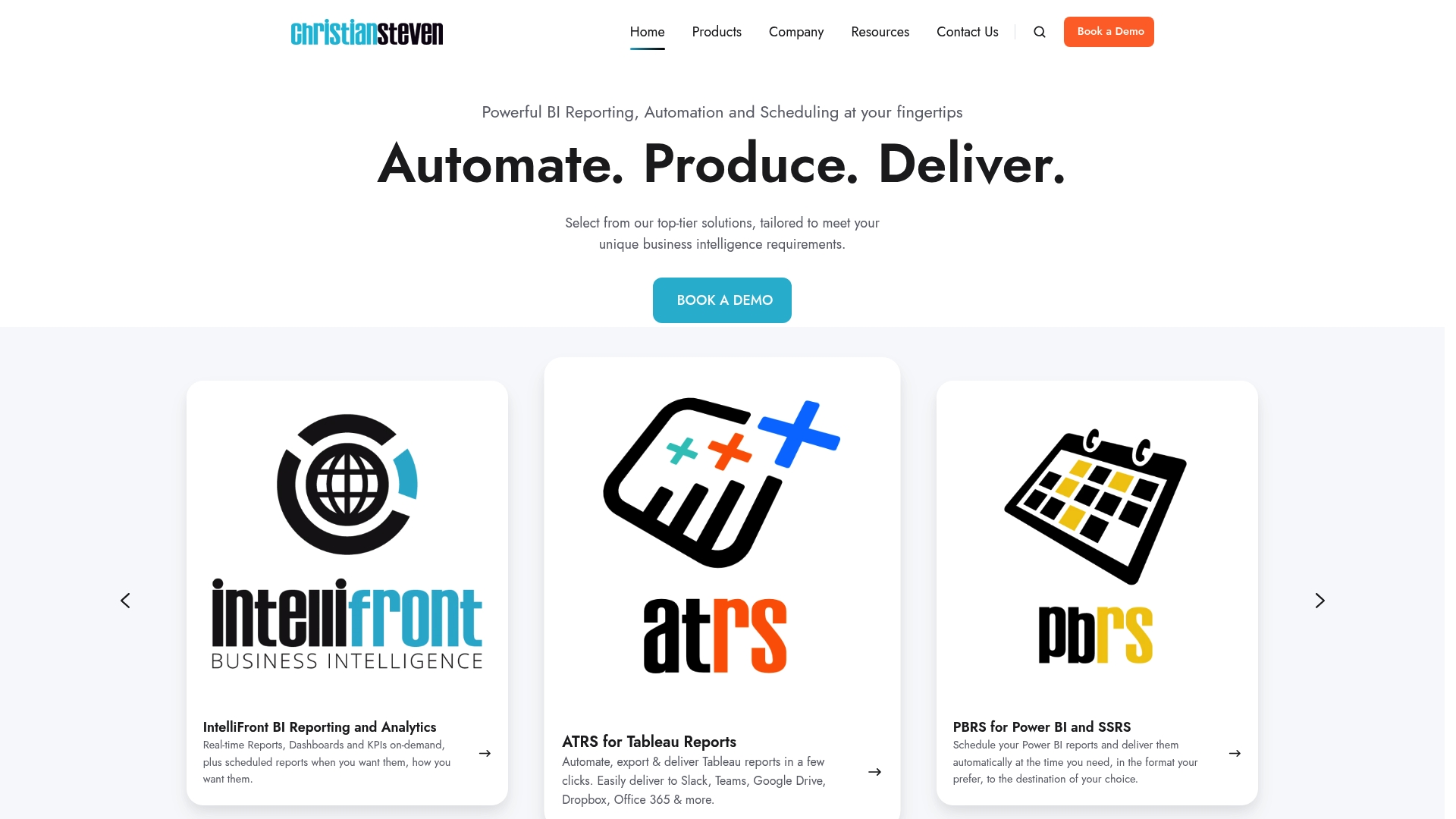
The product lineup maps directly to what most enterprise stacks actually run:
- PBRS handles Power BI scheduling, formatting, and delivery, including automated email distribution with advanced customization.
- ATRS brings the same automation depth to Tableau report delivery.
- CRD automates Crystal Reports scheduling and export for teams still running that engine in production.
- IntelliFront BI covers real-time dashboards and KPI monitoring for teams that need live visibility alongside scheduled exports.
These products typically include run-history logging, encrypted delivery, and error handling capabilities important for enterprise deployments. If you're ready to see how this fits your environment, request a demo or start a free trial to test it against your own report engine before committing.
Sources
- Power BI Service vs Power BI Report Server: Key Differences - Gethyn Ellis
- Enterprise BI and Reporting Software Options 2026
- Best automated reporting tools in 2026 | Basedash
FAQ
Do I Really Need an On-Premises Tool Instead of Cloud?
If data residency, compliance audits, or air-gapped networks apply to your organization, yes. Cloud-native tools work well for teams without those constraints, but they can't guarantee the same physical control over report data.
What Should a Proof of Concept Actually Test?
Run your most complex real report, not a demo file, through scheduling, delivery, and export fidelity checks, and confirm row-level security holds at export time. Score vendors on how they handle failures, not just successful runs.
How Long Does a Typical Migration Take?
Timelines vary by report inventory size, but a structured migration with a full report audit, credential mapping, and RLS testing typically takes several weeks for a mid-sized deployment, not a single weekend cutover.
Is ChristianSteven Software Suitable for Mixed BI Environments?
Yes. Its product line covers Power BI (PBRS), Tableau (ATRS), Crystal Reports (CRD), and real-time dashboards (IntelliFront BI), which fits organizations running more than one reporting engine at once.
What's the Biggest Red Flag When Evaluating Alternatives?
No detailed run history or error alerting. Without that, failed deliveries go unnoticed until a stakeholder asks why a report never arrived, which is far too late for a compliance-driven workflow.